Stamp Collecting Guide: Identify, Organize, and Value
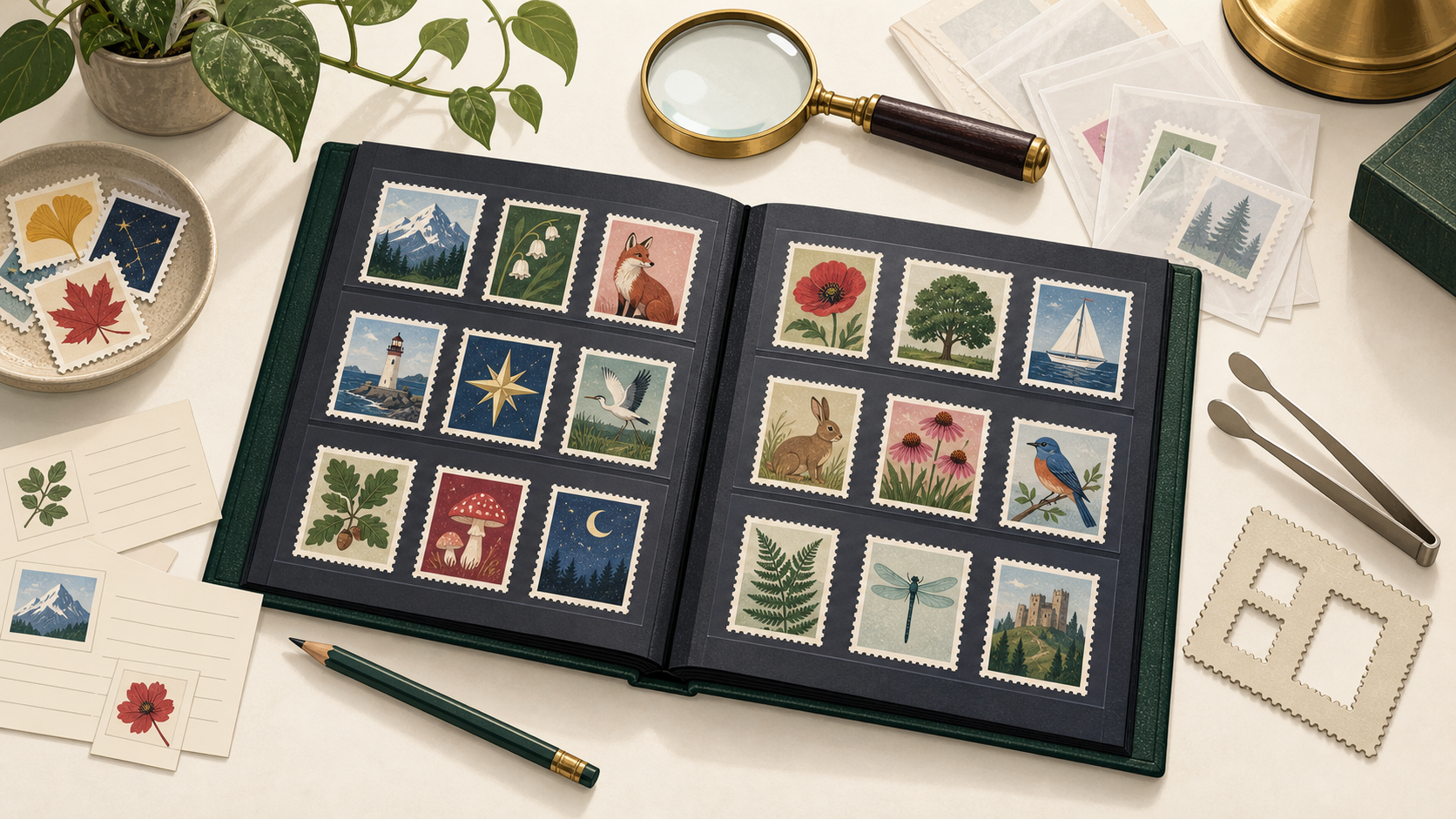
A postage stamp collection is usually simply called a stamp collection; the study and collecting of stamps and postal history is philately. You do not need rare material to begin. A useful collection starts with a clear scope, reliable identification, safe handling, and records that let you explain what each item actually is.
Choose a collecting goal before buying supplies
A collection can follow a country, time period, topic, postal service, printing method, mail route, or one issue in depth. The goal determines what belongs and prevents a box of unrelated material from becoming an unmanageable project.
- Country or region: organize by issuing authority and period, including historical boundary changes.
- Topical: collect subjects such as wildlife, art, space, holidays, or notable people while recording the actual issuer.
- Issue study: compare denominations, formats, plate positions, papers, perforations, watermarks, and documented varieties.
- Postal history: preserve the complete cover, markings, route, and rate evidence instead of removing the stamp.
Identify first, value second
Two stamps with similar artwork can be different issues or varieties. Before looking for a price, record the country or issuing entity, denomination, full inscription, approximate date, color, perforations, watermark if safely visible, gum, cancellation, format, and condition. For worldwide material, use our world postage stamp identification hub to choose the right country or period.
The American Philatelic Society’s getting-started resources provide collecting education, while the Smithsonian National Postal Museum offers authoritative collection and postal-history context.
Basic tools that protect the material
| Tool | Purpose | Common mistake to avoid |
|---|---|---|
| Stamp tongs | Handle stamps without transferring skin oils | Using sharp household tweezers that crease or puncture paper |
| Magnifier | Inspect printing, damage, and small design differences | Treating visual similarity as conclusive identification |
| Perforation gauge | Measure perforation spacing consistently | Counting holes instead of using the gauge scale |
| Stockbook or archival mounts | Store material without permanent adhesive | Using tape, glue, PVC pages, or pressure-sensitive albums |
| Catalog and inventory | Record identity, source, cost, and notes | Assuming a catalog number alone proves authenticity or value |
Condition and preservation
Store stamps in a stable, dry environment away from direct sunlight, heat, pests, and rapid humidity changes. Keep albums upright and avoid overfilling pages. Do not attempt to remove hinges, cancel marks, stains, or envelopes until you know whether the treatment could destroy evidence or reduce value. A stamp on cover may be more informative than the detached stamp.
How collectors estimate value
Postage value and collector market value are different. A responsible estimate starts with the exact issue and variety, then considers centering, margins, perforations, gum, cancellation, faults, provenance, certification, and demand. Catalog values are reference points, not guaranteed sale prices. Compare recent completed sales for the same object and condition; do not substitute an asking price for a transaction.
For potentially valuable material, preserve it as found and consult a recognized expertizing service or specialist. A photograph can support preliminary identification, but it cannot establish paper, gum, repairs, hidden faults, or authenticity on its own.
Build a record you can hand to someone else
- Assign an inventory number and take front-and-back photographs.
- Record issuer, date, denomination, catalog reference and edition, format, condition, and cancellation.
- Record where and when you obtained it, the amount paid, and any certificate or receipt.
- Keep uncertain identifications labeled as tentative.
- Back up the inventory separately from the physical collection.
Explore documented stamp stories
Issue-focused articles show how context changes identification. Read our guides to Native American subjects on U.S. postage, Batman on U.S. stamps, and Dungeons & Dragons stamps.
Frequently asked questions
What is a stamp collector called?
A stamp collector may be called a philatelist, especially when the person studies stamps and postal history as well as collecting them.
Should used stamps be soaked off envelopes?
Not automatically. First determine whether the cover, postmark, route, rate, or other markings have postal-history value. Modern self-adhesive stamps may also be difficult to remove safely.
Are old stamps always valuable?
No. Age alone does not establish scarcity, demand, condition, or authenticity. Exact identification and comparable evidence matter more.
Reviewed September 12, 2026. Market values change, and this guide does not authenticate or appraise a specific item.