Blog
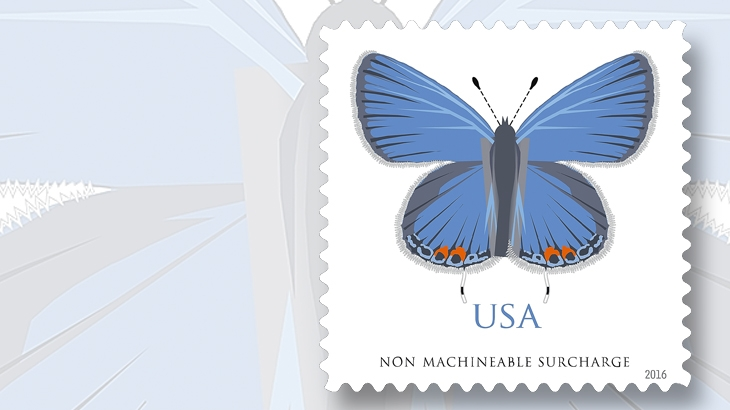
Eastern Tailed-Blue USPS Stamp Guide


The Eastern Tailed-Blue stamp belongs to the U.S. Postal Service tradition of butterfly designs associated with nonmachinable First-Class Mail. This guide separates the stamp’s postal purpose from its artwork and from the living species it depicts.
What the stamp is
USPS issued the Eastern Tailed-Blue stamp on September 24, 2016, in Kansas City, Missouri. Item 119500 was sold in panes of 20 as a nondenominated Non-machineable Surcharge rate stamp with an initial price of 68 cents; the rate-category inscription, not a fixed number, governs its postal value.
“5136” is the Scott catalog number; USPS used Item 119500 for the pane. Naming both systems prevents a collector’s catalog reference from being mistaken for an order number.
How to use it correctly
The Eastern Tailed-Blue was introduced at 68 cents, but the stamp carries a rate-category inscription rather than a printed 68-cent denomination. For a later mailing it follows the current Non-machineable Surcharge category on an eligible letter; additional weight or a different classification remains a separate charge.
A square greeting-card envelope is a likely use, but shape is not the only test. Measure and weigh the card after adding every enclosure, and check thickness, flexibility, and uniformity. A piece outside letter standards does not become eligible merely because it bears a surcharge-rate stamp.
At the domestic prices effective July 12, 2026, a qualifying one-ounce nonmachinable letter requires 82 cents for the one-ounce letter price plus a 49-cent surcharge, totaling $1.31. An unused Eastern Tailed-Blue covers that named one-ounce nonmachinable category. If the same eligible letter weighs 1.3 ounces, the additional-ounce amount is 29 cents, bringing the dated example to $1.60. These figures must be recalculated for the actual mailing date.
About the Eastern Tailed-Blue
The USPS issue announcement identifies the pictured insect as a first-generation male Eastern Tailed-Blue (Cupido comyntas). Its iridescent blue upper surface, short thread-like hind-wing tails, and small orange spots are features visible in the issued illustration, not postal-rate markings or a complete field-identification key.
Tom Engeman created the artwork digitally from preserved specimens. The white square enlarges the butterfly, while the usage inscription beneath it identifies the postal purpose.
The USPS announcement reproduces the issued design and pane specifications, making it the primary visual comparison. Its compact silhouette and white field distinguish this stamp from larger swallowtail designs in the related issue chronology.

Collecting and authenticity
Compare the first-generation male image, pane format, inscription, and USPS item record before relying on subtler production traits. Color, tagging, die cutting, or microprinting may assist examination, but none is an independent guarantee. Condition and format must also be stated in any collectible comparison.
Sources
Key facts were checked against USPS Stamp Announcement 16-37; USPS domestic mailing standards; Smithsonian National Postal Museum.